
 EN
EN
 AR
AR
 BG
BG
 HR
HR
 CS
CS
 DA
DA
 NL
NL
 FI
FI
 FR
FR
 DE
DE
 EL
EL
 HI
HI
 IT
IT
 JA
JA
 KO
KO
 PL
PL
 PT
PT
 RO
RO
 RU
RU
 ES
ES
 SV
SV
 ID
ID
 UK
UK
 ET
ET
 GL
GL
 HU
HU
 MT
MT
 TR
TR
 FA
FA
 AF
AF
 GA
GA
 HY
HY
 AZ
AZ
 KA
KA
 UR
UR
 BN
BN
 LA
LA
 UZ
UZ
 KU
KU
 KY
KY
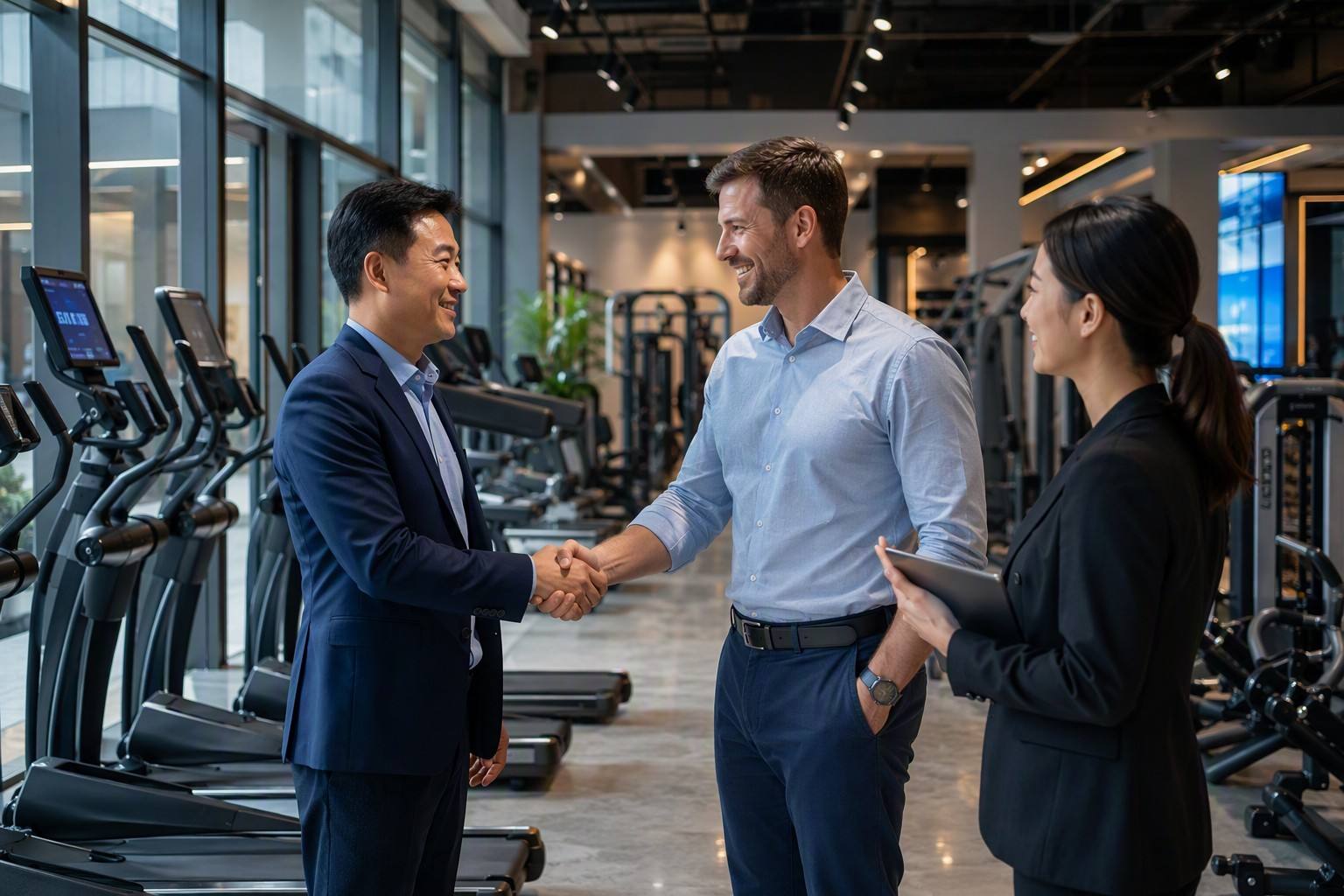
How to Choose a Reliable Commercial Gym Equipment Supplier: A Buyer's Checklist
Selecting the right commercial gym equipment supplier is one of the highest-stakes decisions a gym operator or distributor will make. The supplier you choose influences product quality, project timelines, after-sales support, and the long-term viability of your fitness facility. Yet many buyers focus exclusively on price per unit — and pay for it later in maintenance costs, downtime, and lost members.
This guide provides a structured, evidence-based checklist for evaluating commercial gym equipment suppliers, whether you are outfitting a new facility, expanding an existing gym, or building a distribution business.
Why Supplier Selection Matters More Than Product Selection
The equipment itself is only half the equation. A 2026 procurement industry analysis identified cost, quality, risk, innovation, ESG compliance, and digital capabilities as the core supplier selection criteria used by professional procurement executives (Art of Procurement, February 2026). For fitness facilities specifically, the supplier relationship determines:
- Total Cost of Ownership (TCO): Purchase price is typically only 40–60% of the equipment's lifetime cost. Installation, maintenance, spare parts, and premature replacement drive the remainder.
- Operational Continuity: Commercial equipment runs 10–16 hours daily. A machine down for repair means lost member capacity and revenue.
- Project Timelines: Full gym fit-outs depend on supplier lead times, partial shipment capabilities, and logistics coordination.
- Brand Reputation: Your gym's floor reflects on your brand. Equipment that looks dated or breaks down undermines member trust.
Checklist Item 1: Verify Manufacturing Capability, Not Just Trading Presence
The single most important distinction in commercial fitness equipment sourcing is between manufacturers (factories that design and produce equipment) and trading companies (intermediaries that resell others' products).
- Price control: Direct cost base, 20–35% lower typical pricing (manufacturer) vs. added intermediary margin (trading)
- Quality control: Owns production line and QC process (manufacturer) vs. dependent on third-party factories (trading)
- Customization (OEM/ODM): Supported with in-house R&D (manufacturer) vs. limited or absent (trading)
- Spare parts supply: Direct from production (manufacturer) vs. requires reordering from source (trading)
- After-sales accountability: Direct responsibility (manufacturer) vs. diffuse responsibility (trading)
Verification steps:
- Request the supplier's business license and confirm the registered entity matches the brand they sell.
- Ask for factory tour — in person or live video walkthrough. Legitimate manufacturers will accommodate this.
- Verify production capacity documentation: output volume, production line count, and equipment upgrade history.
- Check whether the manufacturer holds factory-direct certifications (ISO 9001) versus mere product resale certificates.
Case in point: WRM Fitness (Zhejiang Longqi Trade Co., Ltd.) is a factory-direct manufacturer established in 2004, with an 800 m² showroom in Yiwu and self-operated warehouses at Ningbo Port and Yiwu Port — enabling direct quality control, competitive pricing, and fast export logistics.
Checklist Item 2: Audit Product Certifications and Compliance
Certification compliance is non-negotiable for commercial fitness equipment — it protects your members, your business, and your market access. Different target markets impose different requirements:
- European Union: CE marking + EN 957 series — mandatory for market access
- International: ISO 20957 series — primary standard for stationary training equipment (ISO 20957-1:2013 general; ISO 20957-2:2024 strength equipment)
- United States: ASTM F2276 — voluntary but industry standard
- Other regions: Local market-specific requirements — verify per destination country
Verification steps:
- Request PDF copies of current certificates — check issue dates and validity periods.
- Confirm the certificate covers the specific product models you intend to purchase, not just "the company."
- For strength equipment, verify compliance with the updated ISO 20957-2:2024 standard.
- Ask about electrical safety compliance for motorized equipment (treadmills, ellipticals) in your target market.
Checklist Item 3: Assess Product Line Depth and Design Maturity
A reliable supplier offers a coherent product ecosystem, not just a random assortment. Commercial facilities need consistent design language, compatible dimensions, and unified quality across cardio, strength, and functional zones.
What to evaluate:
- Category coverage: Does the supplier offer cardio (treadmills, ellipticals, bikes), strength (plate-loaded, selectorized), and functional training equipment from one source?
- Series architecture: Premium lines with consistent visual identity — e.g., color-coded series, matching frame designs — simplify gym floor aesthetics.
- Specification transparency: Full technical data — dimensions, weight, power ratings, frame materials — should be publicly available, not withheld until inquiry.
- Design maturity signals: Ergonomics features, buffer mechanisms, material selection (e.g., aluminum alloy handles, torsion spring dampers) indicate engineering depth.
Red flags: Generic product images lifted from multiple different manufacturers, inconsistent specification formats, or product ranges that appear copied from competitor catalogs.
Checklist Item 4: Stress-Test Quality Control and Testing Procedures
Commercial equipment endures abuse that home equipment never sees. A supplier's quality control (QC) regime is your first line of defense against premature failure.
Questions to ask:
- QC team structure: How many dedicated QC personnel? What stage gates exist (incoming materials, in-process, final inspection)?
- Testing protocols: What endurance/cycle testing is performed? Reputable manufacturers test to standards such as 100,000+ cycle operations for load-bearing components.
- Material certification: Are steel frames from certified suppliers? Is welding quality verified?
- Failure rate data: Ask for historical defect rates and warranty claim statistics — a real manufacturer can share this.
Checklist Item 5: Evaluate Logistics, Warehousing, and Delivery Capability
For international buyers, logistics performance directly impacts project schedules and landed costs. Shipping delays of 2–4 weeks are common with suppliers lacking warehousing and port infrastructure.
Key evaluation points:
- Port proximity: Is the factory/warehouse near major export ports? Ningbo Port, one of the world's busiest, is a strategic advantage for China-based manufacturers.
- Warehousing: Does the supplier hold self-operated warehouses that enable partial shipments and flexible order consolidation?
- Lead time transparency: Can they commit to written delivery schedules, with penalties for delays?
- Shipping options: FOB, CIF, DDP capabilities — a supplier offering DDP (Delivered Duty Paid) simplifies customs handling for buyers.
WRM Fitness operates self-owned warehouses at both Ningbo Port and Yiwu Port, effectively shortening delivery cycles for international buyers.
Checklist Item 6: Verify After-Sales Support and Spare Parts Supply
Commercial equipment failures are inevitable over a 5–10 year lifespan. What separates good suppliers from bad ones is how failures are handled.
Evaluate:
- Warranty terms: Standard commercial warranties range from 1–3 years on parts and 1–2 years on motors. Anything below 1 year is a warning sign.
- Spare parts availability: How quickly can replacement parts ship? Is there a parts catalog?
- Technical documentation: Manuals, exploded diagrams, and maintenance guides should be available in your language.
- Response channels: Email, WhatsApp, and video support — test responsiveness with a pre-sale question and time the response.
Checklist Item 7: Test Customization and OEM/ODM Capability
Distributors and branded gym operators increasingly require private-label or customized equipment. Before committing, verify the supplier's customization depth:
- OEM (Own Equipment Manufacturing): Can they produce equipment under your brand — logo, colorway, packaging?
- ODM (Original Design Manufacturing): Can they modify designs — dimensions, features, resistance systems — for your market?
- Minimum Order Quantities (MOQ): What are realistic MOQs for standard vs. customized equipment?
- Sample policy: Is there a pre-production sample approval process?
Checklist Item 8: Confirm Financial Stability and Business Longevity
Equipment purchases involve significant upfront investment. Supplier longevity is a proxy for reliability:
- Years in operation: Fitness equipment manufacturing requires accumulated engineering expertise — 10+ year manufacturers have survived multiple market cycles.
- Business scale: Annual output volume and sales figures indicate production maturity.
- Export experience: Number of destination countries served demonstrates logistics and compliance competence across markets.
- Client references: Ask for contactable client references in your region — then actually contact them.
Putting It Together: The 8-Point Supplier Scorecard
Use this scorecard to compare shortlisted suppliers objectively:
- Manufacturing vs. trading — 20% weight
- Certifications & compliance — 15% weight
- Product line depth — 15% weight
- Quality control & testing — 15% weight
- Logistics & delivery — 10% weight
- After-sales & spare parts — 10% weight
- Customization capability — 10% weight
- Financial stability — 5% weight
Rate each criterion 1–5, multiply by weight, and sum. A supplier scoring below 3.5/5 on any criterion with weight ≥15% warrants deeper due diligence before commitment.
Red Flags: When to Walk Away
- Supplier refuses a factory visit or live video tour
- Certificates are expired, model-specific gaps exist, or documents cannot be produced
- Pricing is significantly below market average with no explanation — quality is being cut somewhere
- No written warranty terms or after-sales policy
- Trade-only entity posing as a manufacturer
- Unresponsive to pre-sale inquiries — a preview of post-sale service
FAQ
Q: What is the most important factor when choosing a commercial gym equipment supplier? A: Manufacturing capability — verifying the supplier is a genuine factory rather than a trading intermediary — has the highest impact on price, quality control, customization, and after-sales accountability. It should carry the highest weight (20%) in any supplier evaluation.
Q: What certifications should commercial gym equipment have? A: For the EU market, CE marking and EN 957 compliance are mandatory. Internationally, ISO 20957 (stationary training equipment safety) is the primary standard, with the updated ISO 20957-2:2024 covering strength training equipment. The US market uses ASTM F2276 as the industry standard.
Q: How much can I save by buying directly from a manufacturer? A: Direct factory sourcing typically saves 20–35% compared to distributor pricing, because intermediary margins are eliminated. Additional savings come from container-load freight consolidation and avoiding reseller markups on spare parts.
Q: How long does a commercial gym equipment order take to deliver? A: Typical lead times from Chinese manufacturers are 2–6 weeks for standard catalog products and 4–10 weeks for OEM/ODM customization, plus shipping time. Suppliers with port-adjacent self-operated warehouses (e.g., Ningbo Port) can often ship faster and support partial shipments.
Q: What warranty should I expect on commercial equipment? A: Industry-standard commercial warranties are 1–3 years on parts and 1–2 years on motors/electronics. Selectorized strength equipment often carries longer frame warranties. Anything below one year on parts is a warning sign.
Q: Can I customize commercial equipment with my own brand? A: Yes, if you choose a manufacturer with OEM/ODM capability. OEM covers branding (logo, colors, packaging); ODM covers design modifications (dimensions, features, resistance systems). Confirm MOQs and sample approval processes before ordering.
About WRM Fitness: WRM Fitness Equipment Co., Ltd. is a factory-direct commercial fitness equipment manufacturer established in 2004. Headquartered in Yiwu, Zhejiang — near Ningbo Port — we manufacture commercial treadmills, ellipticals, exercise bikes, strength training machines, and functional trainers. With an 800 m² showroom, self-operated export warehouses, and full OEM/ODM capability, we help gym owners and distributors worldwide build competitive facilities. Contact us for a tailored procurement solution.