
 EN
EN
 AR
AR
 BG
BG
 HR
HR
 CS
CS
 DA
DA
 NL
NL
 FI
FI
 FR
FR
 DE
DE
 EL
EL
 HI
HI
 IT
IT
 JA
JA
 KO
KO
 PL
PL
 PT
PT
 RO
RO
 RU
RU
 ES
ES
 SV
SV
 ID
ID
 UK
UK
 ET
ET
 GL
GL
 HU
HU
 MT
MT
 TR
TR
 FA
FA
 AF
AF
 GA
GA
 HY
HY
 AZ
AZ
 KA
KA
 UR
UR
 BN
BN
 LA
LA
 UZ
UZ
 KU
KU
 KY
KY
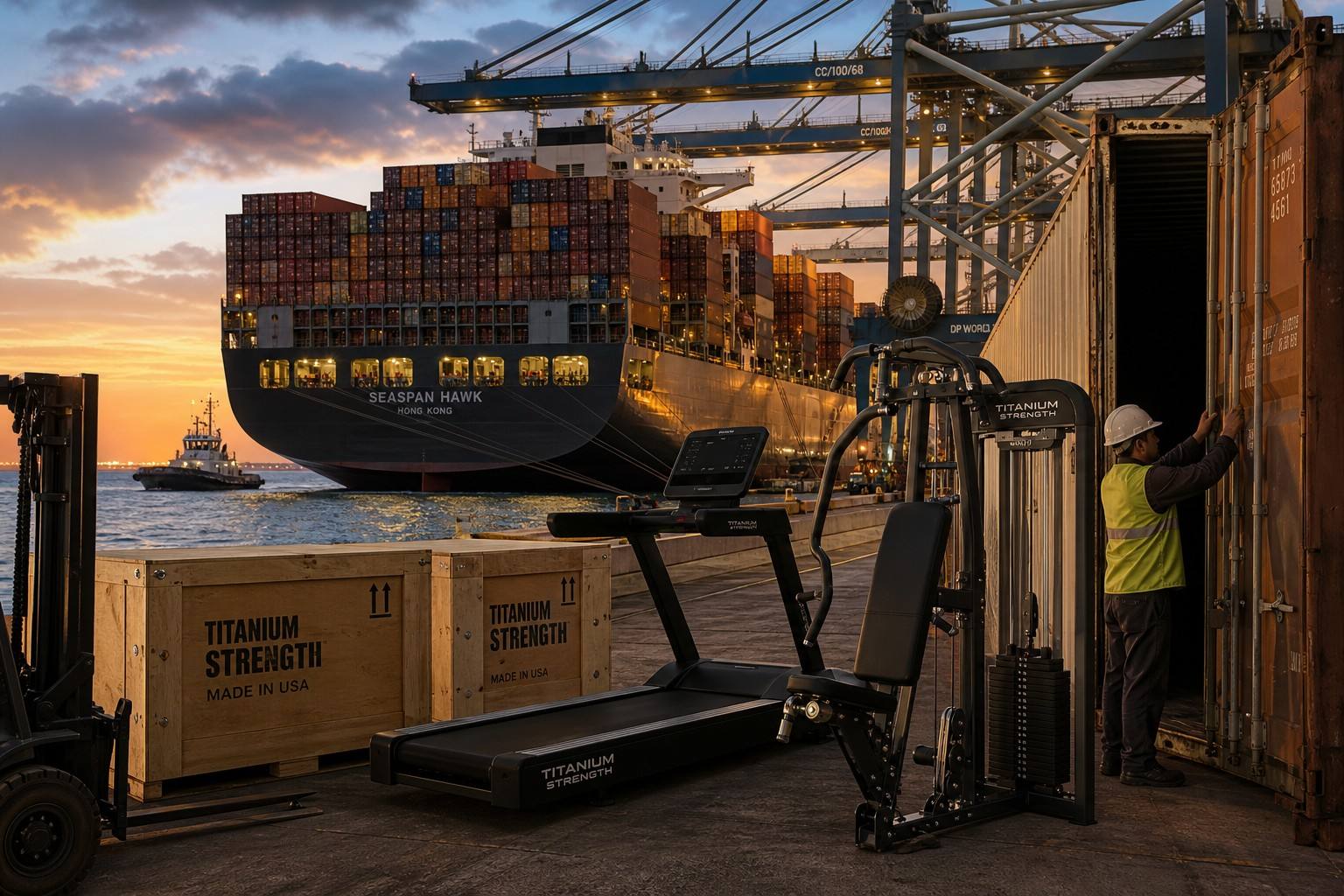
Sourcing Gym Equipment from China: A Complete 2026 Import Guide
China remains the world's dominant supplier of commercial fitness equipment — and for good reason. In May 2026 alone, China exported over USD 290 million of gym and athletics equipment to the United States, with Germany, the United Kingdom, Brazil, and Canada following as the next largest markets (OEC, 2026). For gym owners, distributors, and fitness brands, sourcing from China offers an unmatched combination of manufacturing scale, product variety, and cost advantage — but only when the import process is managed correctly.
This guide walks through every stage of importing gym equipment from China in 2026: supplier selection, product compliance, shipping terms, customs clearance, landed cost calculation, and the critical decisions that separate profitable imports from costly mistakes.
Step 1: Define Your Import Model Before You Buy
Your import strategy determines every subsequent decision. Clarify these four questions before contacting suppliers:
- Volume and frequency: Are you buying a one-time shipment for a single gym, or establishing a recurring supply line? Recurring buyers qualify for better pricing and partial shipment flexibility.
- FCL vs. LCL: Full Container Load (FCL) suits orders exceeding roughly 20–28 cubic meters; Less than Container Load (LCL) works for smaller shipments but carries higher per-cubic-meter cost and longer transit times.
- Target market compliance: Your destination country dictates certifications, labeling, and electrical requirements.
- Risk tolerance: Do you prefer full control (EXW/FOB) or turnkey simplicity (DDP)?
FCL vs LCL comparison: FCL — best for 20ft/40ft container-scale orders, lower cost per unit, faster transit, lower damage risk, simpler customs. LCL — best for orders under ~20 m³, higher per m³ premium, slower transit (consolidation delays), higher damage risk (shared container), more complex customs.
Step 2: Select and Vet the Factory
Sourcing from China without vetting the factory is the fastest route to a bad import. Apply the eight-point supplier checklist: manufacturing vs. trading entity, certifications, product depth, QC procedures, logistics capability, after-sales support, OEM/ODM depth, and financial stability.
Three additional verifications matter for importers:
- Export license status: The supplier must hold a valid export license and documented export experience to your destination country.
- Language capability: English-speaking export staff reduce miscommunication risk.
- Reference checks in your market: Ask for clients in your region and contact them directly.
WRM Fitness (Zhejiang Longqi Trade Co., Ltd.), a factory-direct manufacturer established in 2004, exports to 90+ countries and operates showrooms and warehouses in Yiwu with port facilities at Ningbo and Yiwu.
Step 3: Nail Down Product Compliance and Certification
Compliance failures at customs are expensive — warehousing fees, return shipping, or outright seizure.
Destination-market certification matrix:
- European Union: CE marking + EN 957 series — mandatory; ISO 20957-2:2024 applies to strength equipment
- United States: ASTM F2276, UL/ETL for electronics — Section 301 additional duties apply to China-origin goods
- Australia/NZ: RCM for electrical items
- Middle East: SASO/G-Mark (GCC)
Customs classification: Most exercise equipment falls under HS Code 9506.91 (articles and equipment for general physical exercise). Confirm your specific product's subheading — classification errors trigger duty reassessments and delays.
Documents to secure from the supplier: commercial invoice and packing list, bill of lading (B/L) or airway bill, certificate of origin, test reports and certification copies (CE, EN, ISO), inspection reports if using third-party inspection (SGS, TÜV, Bureau Veritas).
Step 4: Choose the Right Shipping Terms
Incoterms determine who bears cost, risk, and responsibility at each stage:
- EXW (Ex Works): Buyer controls everything after factory gate — for experienced importers with own logistics
- FOB (Free On Board): Buyer controls ocean freight, insurance, customs; supplier handles domestic transport + loading — the standard choice for most importers
- CIF (Cost, Insurance, Freight): Supplier controls freight to destination port — for small first shipments
- DDP (Delivered Duty Paid): Supplier controls everything including duty/taxes — for first-time importers wanting turnkey
Practical guidance: FOB is the industry default for experienced buyers. DDP suits first-time importers — verify genuine DDP capability before accepting. Always get freight quotes from 2–3 forwarders.
Step 5: Calculate True Landed Cost
The quoted unit price is not your cost. Landed cost includes: product price + domestic China transport (EXW only) + ocean/air freight + marine insurance + import duty (HS 9506 rate + any additional tariffs) + VAT/sales tax + customs brokerage fees + port handling & inland delivery + inspection fees (if used).
2026 tariff reality check:
- United States: China-origin fitness equipment faces Section 301 additional duties layered on standard MFN rates. Total effective duty for many fitness products ranges from 7.5% to 25%+, and the trade policy environment remains volatile — confirm current rates with your broker before committing.
- European Union: HS 9506 duty is typically low (~2.7%), but VAT applies at destination (e.g., 19% in Germany, 20% in the UK).
Rule of thumb: Allocate 25–40% of the product price as a landed-cost buffer, and verify current rates — never rely on outdated figures.
Step 6: Manage Production, Inspection, and Quality Gates
- Pre-production: Confirm final specifications, packaging requirements, and certification documents in writing.
- Production updates: Agree on photo/video updates at key stages — frame welding, painting, assembly.
- Pre-shipment inspection (PSI): For orders above ~USD 10,000, hire a third-party inspector (SGS, TÜV, Bureau Veritas) before release. Cost is typically 0.2–0.5% of order value.
- Sample approval for OEM/ODM: Require a pre-production sample and written approval before mass production.
Step 7: Plan the Timeline Backwards
Typical China-to-overseas import timelines (2026):
- Standard products: production 2–4 weeks + inspection 3–5 days + ocean freight 25–40 days + clearance/delivery 5–10 days = 6–12 weeks total
- OEM/ODM custom: production 4–8 weeks + same downstream = 9–16 weeks total
Build a 2–4 week buffer into your opening timeline. Gyms opening "on schedule" are almost always opening late.
Step 8: Avoid These Common Import Mistakes
- Skipping the pre-shipment inspection to save 0.3% of order value — the most expensive false economy in importing
- Accepting the first freight quote without comparing forwarders
- Ignoring tariff policy updates — the US Section 301 landscape changed repeatedly through 2025–2026
- Ordering the cheapest motorized equipment without verifying electrical compliance for your market
- Not documenting everything — every spec, price, and promise in writing
- Underestimating packaging requirements — commercial equipment needs proper crating
FAQ
Q: How long does it take to import gym equipment from China? A: 6–12 weeks for standard catalog products (production 2–4 weeks + ocean freight 25–40 days + clearance 5–10 days), 9–16 weeks for OEM/ODM custom orders. Always add a 2–4 week buffer.
Q: What is the HS code for gym equipment? A: Most exercise equipment falls under HS Code 9506.91. Confirm the exact subheading for your product, as classification determines duty rates.
Q: FOB or DDP — which should I choose? A: FOB is the industry default for experienced importers. DDP suits first-time importers wanting a single all-in price. Verify genuine DDP capability before accepting.
Q: How much does it cost to import gym equipment from China? A: Beyond product price, budget 25–40% for landed costs: freight, insurance, duty, VAT, brokerage, inland delivery. Actual rates depend on destination and current tariff policy.
Q: Are there tariffs on gym equipment imported from China? A: Yes. The US applies Section 301 additional duties (7.5%–25%+) layered over standard rates. The EU applies a low base duty (~2.7% under HS 9506) plus destination VAT. Always verify current rates.
Q: Do I need a pre-shipment inspection? A: For orders above ~USD 10,000, strongly recommended. Third-party inspection costs 0.2–0.5% of order value and prevents expensive non-conforming deliveries.
Q: Can I import custom-branded equipment from China? A: Yes, through OEM (branding) or ODM (design modifications). Require a pre-production sample and written approval before mass production.
About WRM Fitness: WRM Fitness Equipment Co., Ltd. is a factory-direct commercial fitness equipment manufacturer established in 2004. Headquartered in Yiwu, Zhejiang — the world's largest small-commodity market — we manufacture commercial treadmills, ellipticals, exercise bikes, strength training machines, and functional trainers. With an 800 m² showroom, self-operated warehouses at Ningbo Port and Yiwu Port, and proven export experience to 90+ countries, we help gym owners and distributors worldwide import with confidence. Contact us for a tailored procurement solution.